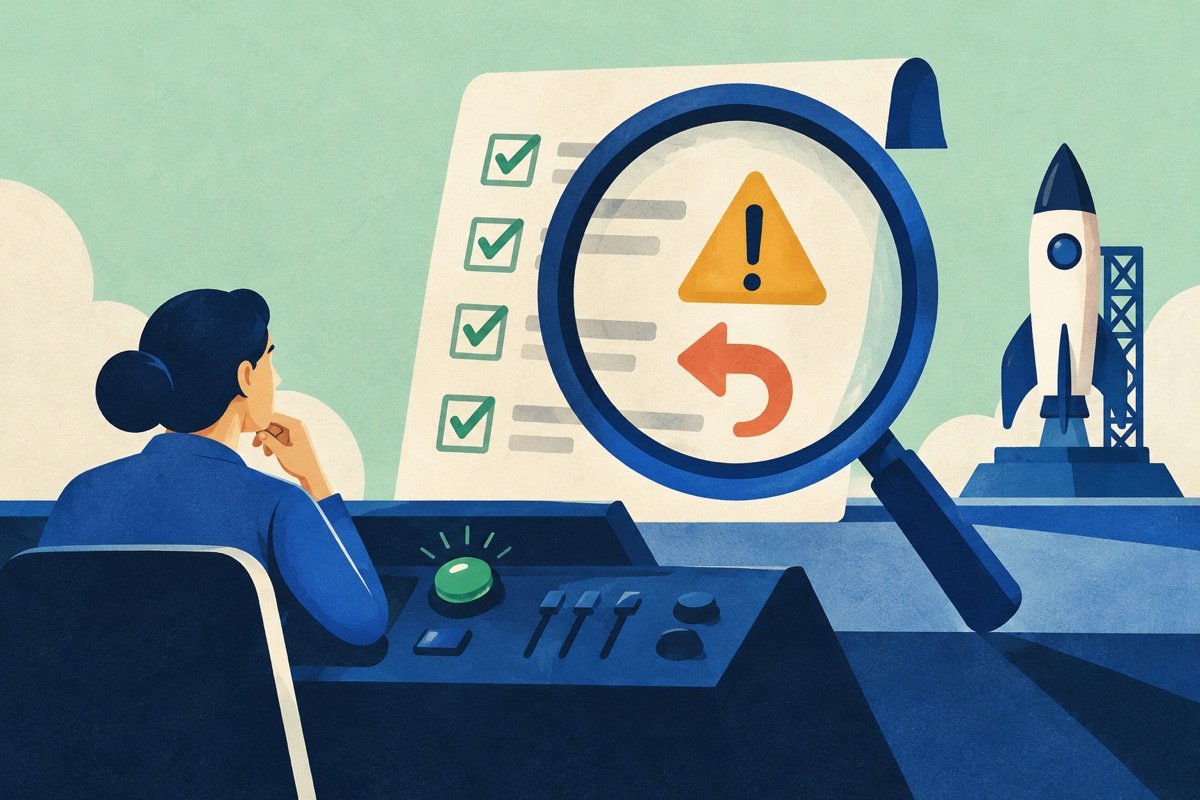

Automation is useful when a check needs to run repeatedly and its result can be judged clearly. Before choosing a tool, decide which product failures would matter most to your users and team.
Choose a critical, repeatable journey
Sign-in, a key account action, and a sandbox checkout can be good candidates when they are stable and important to the product. The best first journey depends on your actual release risks.
Ask three questions: how often do we repeat this check, what happens if this journey breaks, and can we control the data and environment well enough to make the result useful?
Define what success means
A script that reaches a screen is not necessarily checking the right outcome. Agree what must be true at the end: the account was created, the expected total was shown, or the booking was confirmed.
Choose assertions around meaningful behavior. Add detail where it helps detect a real regression, rather than matching every visual implementation choice.
Treat setup as part of the work
Dedicated accounts, predictable data, suitable environments, and clear run instructions are part of an automation suite. Without them, a failure may tell you more about the setup than about the product.
For mobile apps, the agreed operating systems and device setup also affect coverage. Web and native app automation need tools and environments suited to each surface.
Make a failure easy to investigate
The person reading the result should understand which journey failed and where to start looking. Keep useful evidence and instructions for reproducing the problem.
Do not solve every unreliable failure by adding more retries. Investigate whether the cause is the product, test data, environment, or the check itself.
Expand when the first suite earns its place
Start with a small set of high-value checks. Evaluate whether they catch meaningful problems, run reliably, and save repeat work before expanding.
Human exploration remains useful for new features, unclear requirements, unexpected behavior, and questions that do not yet have a fixed expected result. Automation and exploratory testing serve different parts of the same quality effort.